| Home
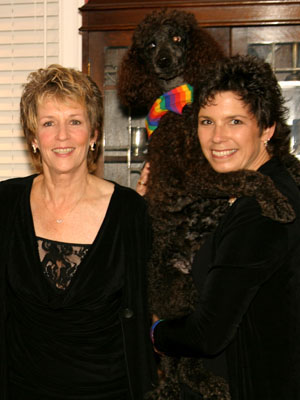
Two Women and A Poodle
on a one-year mission to transform ourselves
and the world, one person at a time!
Engaging Hearts & Minds...
Creating Authentic Connections...
Transcending Differences that Separate Us
You can't hate someone
whose story you know.
 Our year long journey, Our year long journey,
Gay Into Straight America, began September 11, 2005, and was a commitment to creating authentic connections with people who are “wrestling” in some way with their understanding of people's sexual orientation and gender variance.
Wrestling = Movement.
Movement is good, for exposed beneath the "tension and conflict" involved in wrestling, is a deeper dream that possesses both an energy and an opportunity for us to Shift.
We want to help transform our society by serving as a bridge for healing our society's polarization. We want to inspire the movable middle to recognize that change can happen when each of us embarks on our own journey toward living authentic lives. We want to encourage each person, wherever you are at on this journey, to
JOIN THE CONVERSATION...
Whatever It Takes!
WHO is the Movable Middle?
1) People who are wrestling with their understanding of gay, lesbian, bisexual and transgender persons.
2) People in our own GLBTA community (yes, allies too), who are wrestling and being held hostage through fear about speaking and living authentically.
3) People who are wrestling because they don't have a foundation for understanding transgender and intersex persons. This includes our own community of gay, lesbian, bisexual, queer, questioning and ally persons, as well as heterosexual persons.
How can we change the world if we don't know our neighbors? This question led us to realize that, "You can't hate someone whose story you know." That works both ways. Through everyday interactions, sharing meals and conversations, and staying in people's homes, our intention is engaging hearts and minds, creating authentic connections, and dissolving/transcending differences that separate us. Being inclusive, we also avail ourselves to those who hold firm beliefs that do not match our sense of who we are.
As part of this journey, we are speaking to groups and organizations, such as churches, PFLAG chapters, high schools, Gay/Straight Alliances, and colleges/universities.
Our commitment to take this yearlong journey, Gay Into Straight America, brewed for a long time. It first began with our involvement with Soulforce. (Thank you Mel White and Gary Nixon, for your vision of utilizing the practice of relentless nonviolent resistance to help free oppressed sexual and gender minorities from religious and political oppression).
Another seed was planted with our simple vow of intention spoken to one another at our spiritual wedding ceremony on July 31, 2004. (Civil marriage was in Portland, March 7, 2004)
I come to you with an open heart,
and vow to change the world
through the expression of our love.
The final catalyst came on March 9, 2005. We were reading The Advocate Magazine, and saw an article about the journey of Lars Clausen, the Lutheran minister whose journey Straight Into Gay America was to begin on June 14, 2005. Reading his blog inspired us to “Just do It!,” setting the date, September 11, 2005, for our journey to begin!
We were ecstatic about meeting with Lars face-to-face on Memorial Day, 2005, reveling in our parallel journeys. Frankly, we were smitten with one another from the moment we met! We all agree that the bigger picture is about moving beyond political and religious polarization. Our opportunity encompasses relinquishing myths, untruths and caricatures we have painted of one another, bridging the divide that is paralyzing us.
Our Connecting Threads theory says that 10% of us affect 100% of society. Our question to each new person we meet is this: Do you know a gay, lesbian, bisexual, transgender, queer, questioning, or intersex person?
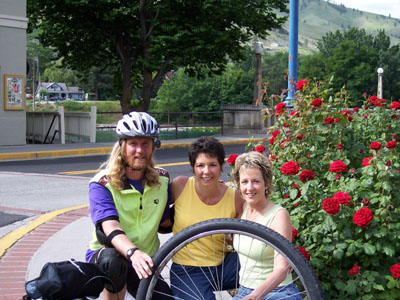
Without exception, every single person we have met has said, "Yes." At the same time, these connections are like the elephant in the living room. We act as if they are hidden and don’t exist as we continue to crash into them and bloody ourselves, driving wedges between families and friends with our “family secrets.”
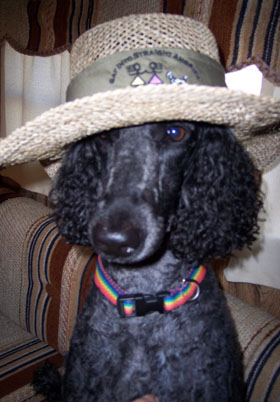
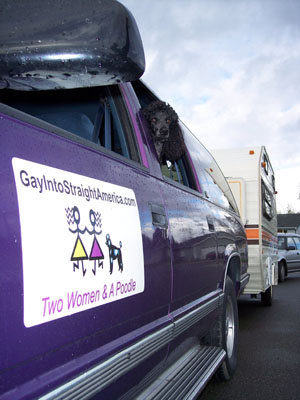
Our desire is to bring light to these beautiful connecting threads, and reiterate our motto "Leave no person behind." Be a part of our team! Follow the adventures of "Two Women and A Poodle" as Dotti, Roby and Rylee Joy travel throughout the United States! Help us build an America we can all believe in, one that offers inclusion, equal rights, protections, and justice for ALL Americans, as guaranteed by our Constitution. Join us in encouraging and supporting authentic human connections between all of us, as healthy, compassionate, and diverse families come together and create a better society and a more empowered future.
Please follow our journey by joining our email list so
you can receive our updates and newsletter.
When I was a stranger,
you invited me in….
Gay Into Straight America
“I tell you the truth, whatever
you did for one of the least
of these brothers of mine,
you did for me.”
Matthew 25: 35-40
The light in us honors the light in you!
Rylee Joy, Robynne Sapp, and Dotti Berry
|